In-house SDR, pay-per-lead, and retainer agencies compared with real cost ranges, so you know what you should actually be paying for qualified pipeline.
Ask five B2B lead generation providers what their service costs and you will get five different answers, none of which are directly comparable, because they are not pricing the same thing. Some quote a monthly retainer. Some quote per lead. Some quote per meeting. Some bundle in ad spend and some do not. None of that helps you build a budget. This breaks down what B2B lead generation actually costs across the three main models, with real ranges, so you can compare a quote against something other than your gut.
The Three Ways B2B Lead Generation Gets Priced
Before comparing numbers, it helps to know what you are actually being quoted, because the same word means different things depending on the vendor.
In-house hire. You employ a BDR or SDR directly. The cost is salary, benefits, tooling, and management time, whether or not any pipeline gets produced this month.
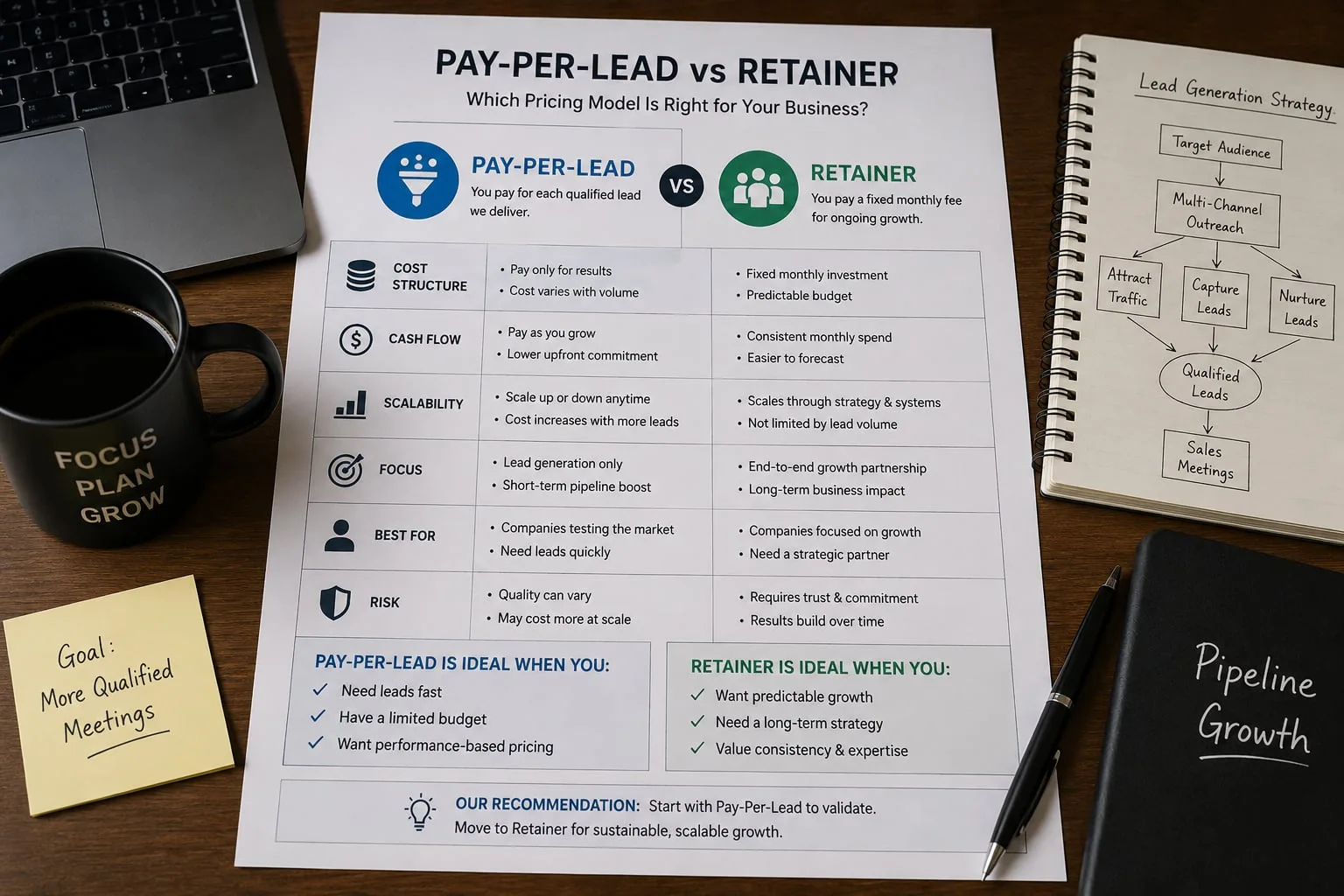
Pay-per-lead or pay-per-meeting. You pay a fixed amount for each qualified output delivered, an interested contact or a booked meeting. No output, no cost, but the per-unit price is usually higher to compensate the vendor for that risk.
Monthly retainer. You pay a fixed fee for a defined scope of outreach activity, list building, sequencing, and SDR time, and output volume is a function of programme maturity rather than a per-unit charge.
In-House SDR: The Real Fully-Loaded Cost
The headline salary is never the real number. A US-based SDR typically costs $60,000 to $85,000 in base salary. Add the pieces most budgets forget:
- Benefits and payroll tax: 20 to 30% on top of base salary
- Tooling: Apollo, Sales Navigator, and a sequencing platform like Outreach or Salesloft run $8,000 to $15,000 per year per seat
- Recruiting cost: 15 to 20% of first-year salary if you use a recruiter, or weeks of internal time if you do not
- Ramp time: 3 to 6 months before a new SDR is producing qualified pipeline at a steady rate, during which you are paying full cost for partial output
Total first-year cost before a single qualified meeting is booked: $100,000 to $160,000 USD, and that is for one person covering one market with one set of messaging. Outside the US, the base salary drops, roughly £45,000 to £70,000 fully loaded in the UK, or €50,000 to €80,000 across most of Western Europe, but the ramp time and tooling overhead do not.
Pay-Per-Lead: Cheap Per Unit, Expensive in Practice
Pay-per-lead pricing usually lands between $50 and $300 per lead, or $150 to $500+ per qualified meeting, depending on ICP seniority and industry. It looks attractive because there is no cost when nothing is delivered.
The problem is what “qualified” means. A pay-per-lead vendor is incentivised to hit volume, not fit, because volume is what they get paid on. Reply rates on this model average 1 to 3%, against 5 to 8% for a properly targeted retainer programme, because the underlying list quality and message relevance are usually lower. You end up paying a lower per-unit price for leads your sales team spends more time disqualifying.
Retainer Agencies: What You Are Actually Paying For
Retainer pricing for a managed B2B lead generation programme typically runs $3,000 to $10,000+ per month, depending on channel mix, target market, and ICP complexity. A single-channel programme (cold email only, one market) sits at the lower end. A multi-channel programme covering outbound, SDR appointment setting, and paid demand generation across more than one region sits higher.
What that retainer buys, when it is structured properly: list building and verification, sending infrastructure setup and warmup, sequence writing and testing, SDR qualification and calendar booking, and weekly reporting. Compare that to the $100,000+ first-year cost of one in-house hire covering a fraction of that scope, and the retainer model is usually the lower-cost option for companies that need pipeline running now rather than in six months.
Side-by-Side Comparison
| Model | Typical Cost | Time to First Meeting | Risk |
|---|---|---|---|
| In-house SDR | $100K–$160K first year, fully loaded | 3–6 months to ramp | Bad hire, ramp cost sunk regardless of output |
| Pay-per-lead | $150–$500+ per meeting | Immediate, quality varies | Volume incentive, weak qualification |
| Retainer agency | $3K–$10K+ per month | 7–14 days to launch, first replies in ~14 days | Vendor quality varies, check ownership terms |
What Actually Drives the Price Within Each Model
Two companies buying the “same” retainer programme can pay very different amounts, and the difference usually comes down to a few factors:
ICP seniority. Targeting VP and C-level buyers at enterprise accounts costs more to research, verify, and reach than targeting mid-level managers at SMBs. List quality at the senior end is harder to build.
Geography. A UK or EU-focused programme requires GDPR-specific infrastructure and, in some markets, different channel mixes entirely. A GCC programme requires different data sources and cultural calibration. None of that is free to build correctly.
Channel count. Cold email alone costs less to run than cold email plus LinkedIn plus paid demand generation, because each channel needs its own infrastructure, creative, and management.
Deal size. Vendors that work on outcome-based pricing scale their per-meeting or per-lead fee to your average deal size, since a meeting with a buyer who might spend $200,000 is priced differently than one with a buyer who might spend $5,000.
What to Ask Before You Sign Anything
Whatever the quoted number, the price alone does not tell you what you are getting. Before comparing quotes side by side, get clear answers on:
- Does the fee include ad spend, tooling, and infrastructure, or are those billed separately
- What counts as a “qualified” lead or meeting, and who validates that
- Do you own the prospect list and creative assets, or does the vendor keep them if you leave
- Is there a minimum term, or is it genuinely month-to-month
- What happens to the price if you want to add a second market or channel later
A lower headline number with vague qualification criteria and no asset ownership is often more expensive than it looks once you account for the leads your team has to filter out manually.
Where This Leaves You
For a company that needs pipeline within a quarter, not by the time an in-house hire ramps, a monthly retainer with a defined qualification standard and clear asset ownership is usually the most predictable cost per qualified meeting. Pay-per-lead can work for narrow, well-defined ICPs where volume matters more than precision. In-house hiring makes sense once your programme is producing enough volume that a dedicated internal resource pays for itself, which is usually after the outsourced motion has already proven what works.
If you want a cost estimate specific to your ICP, deal size, and target market rather than a general range, that is what the strategy call covers. See pay-per-lead vs retainer for a deeper breakdown of when each pricing model actually makes sense, or outsourced SDR vs in-house if you’re weighing whether to hire at all.
Book a Free Pipeline Audit